Over half of pet dogs are overweight, and almost none of their humans think so. The culprit is rarely dinner, it's the chart on the bag (calibrated generously), the treats nobody counts, and the sad eyes at the table. Portions are solvable with a kitchen scale and one honest weekly check.
Daily portions by weight (adult dogs)
Rough starting points for a typical adult on standard dry food (~350–400 kcal per cup). Your dog's metabolism, the food's density, and activity level all shift these, that's what the rib check below is for.
| Dog weight | Calories/day | Dry food (approx.) |
|---|---|---|
| 5 kg / 11 lb | ~350 | ¾–1 cup |
| 10 kg / 22 lb | ~590 | 1½ cups |
| 20 kg / 44 lb | ~990 | 2½ cups |
| 30 kg / 66 lb | ~1350 | 3–3½ cups |
| 40 kg / 88 lb | ~1670 | 4–4½ cups |
Split into two meals for most adults. Puppies eat more per kilo and more often, three to four meals until about six months, and their needs change fast enough that you should re-portion monthly through the first year.
The three rules that matter more than the table
- Weigh the food, don't scoop it. "One cup" by eye drifts 20–30% upward within a month. A kitchen scale ends the drift.
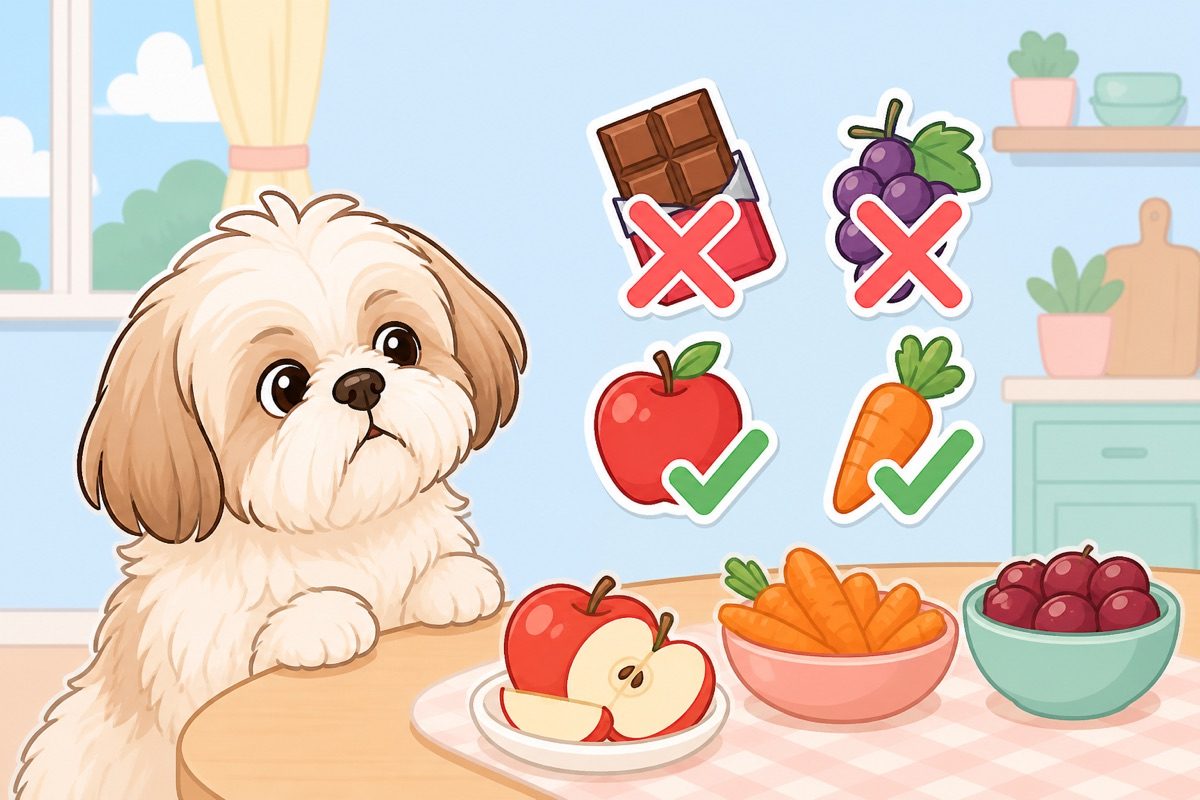
- Treats count, the 10% rule. Everything outside the bowl (training treats, chews, the crust of your toast) should stay under 10% of daily calories. A single dental chew can be a tenth of a small dog's day.
- Feed the dog in front of you. A couch-first shih tzu and a trail-running collie of the same weight can differ by 40% in needs. Activity level is a portion input, if the walks got longer, dinner can grow; if winter turned everyone into a blanket, it shrinks.
The rib check (do this weekly)
Run flat fingers along your dog's ribcage. You should feel ribs easily under a thin layer, like the back of your hand, not see them sharply (too thin), not press to find them (too heavy). From above, there should be a visible waist behind the ribs. This beats every calculator, chart and app, because it measures the actual dog.
When the scale creeps up
Cut portions by 10%, hold for three weeks, re-check. Swap biscuit treats for carrot bits or part of the daily kibble allowance. And log weigh-ins somewhere you'll actually see the trend, monthly weight entries make a slow creep visible long before the vet mentions it. Sudden loss or gain without a portion change is a health-record moment and worth a vet call.